Estimated reading time: 6 minutes
What These Words Mean
You know those days when everything seems to click, and you catch yourself thinking, This might finally be my time? Then, almost without warning, things shift, plans fall through, and the feeling slips away. Confucius captured that fragile turning of circumstances in a way that still stings a little, because you recognize it in your own life.
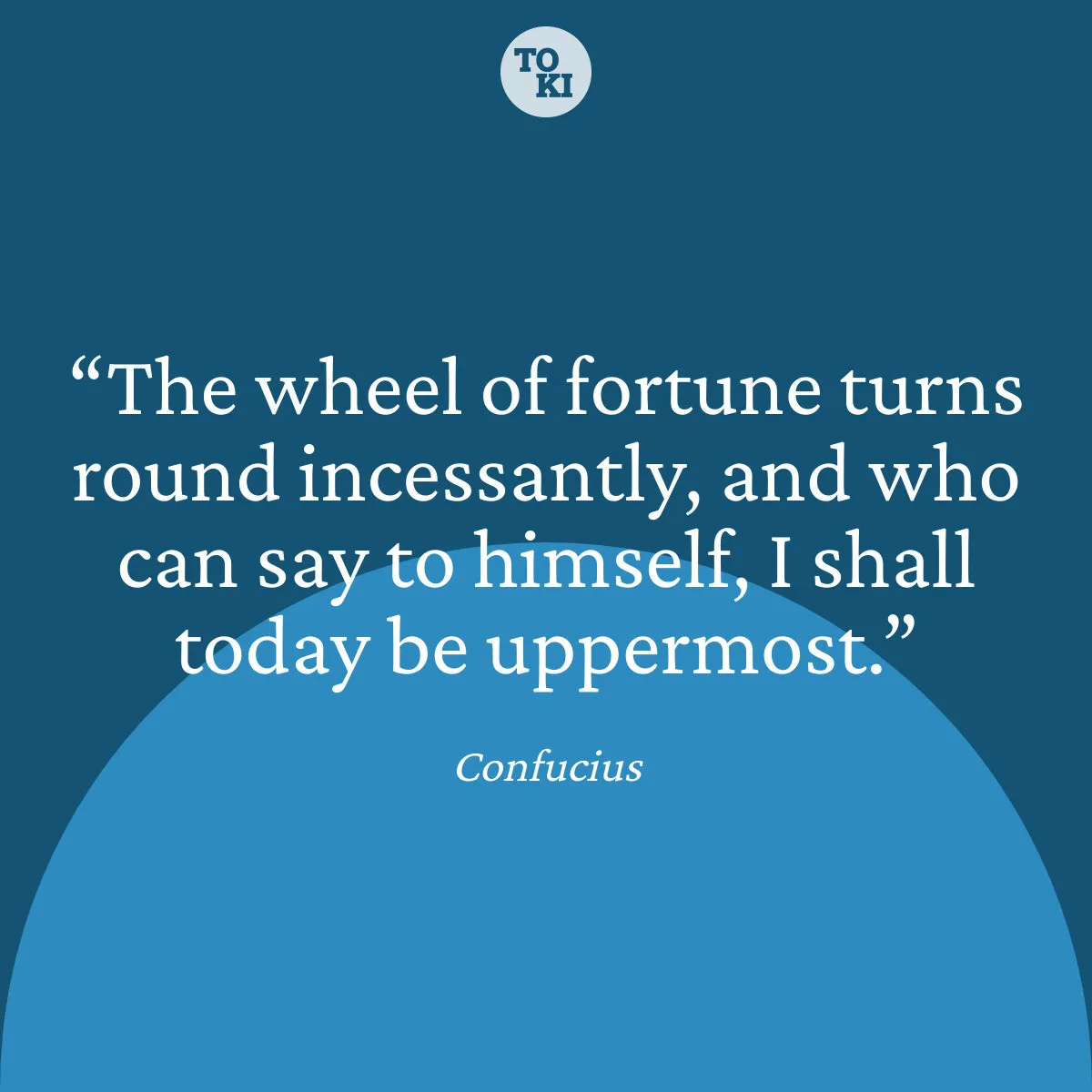
"The wheel of fortune turns round incessantly, and who can say to himself, I shall today be uppermost."
When you hear "the wheel of fortune turns round incessantly," you can picture a large wooden wheel, always moving, never stopping, carrying people up and then down again. On the surface, it is simply a rotating wheel, turning and turning. Inside that picture is a reminder that your situation is never fixed. Money, status, health, relationships, your sense of confidence or despair — all of it is in motion. You stand somewhere on that moving rim, and the point where you stand will not stay at the same height for long. This part of the quote holds a quiet truth: nothing about your current position, whether comfortable or painful, is permanent. It keeps you from clinging too tightly when things go well, and also suggests that when things are hard, they are not frozen that way.
Then come the words, "and who can say to himself, I shall today be uppermost." Here the scene shifts to an inner voice. You picture someone waking up in the morning, maybe with sunlight just beginning to slip between the curtains, saying in their own head: Today I will be on top. Today I will be the one in control. It is a very human thought, almost a small private boast you might not say out loud. These words gently question that confidence. You can hope, you can plan, you can prepare, but you cannot guarantee that today will put you at the highest point of the wheel. There are too many moving parts you do not command — other people's choices, hidden events, the sudden email, the unexpected illness, the break that arrives or never does.
Taken together, the quote moves from a broad picture of constant movement to a direct challenge to your urge for certainty. First, it shows you the restless turning of life's conditions. Then it asks: given that ceaseless turning, how can you honestly tell yourself that you will definitely stand at the top today? It is not trying to shame you for wanting that place; it is questioning the illusion that you can secure it by will alone.
You can feel this in a small, ordinary way. Imagine you have prepared carefully for a job interview. You picked your clothes the night before, rehearsed answers, even checked your commute twice. Your heart speeds up slightly as you step into the building; the air in the lobby feels cool against your skin. Everything in you wants to say, This is it, I am going to win this. But then the interviewer is distracted, or the role budget is suddenly frozen, or another candidate fits better. The wheel has turned in a way no amount of effort could fully control. You might still have done your best and grown from it, but "uppermost" slipped to someone else today.
To me, this quote is not pessimistic; it is almost protective. It nudges you away from the pressure of needing to dominate every day. It suggests a different focus: since you cannot command the turning, perhaps your real strength lies in how you stand while it turns — with some humility when you are rising and some courage when you are falling.
There is, however, a part of life where these words do not fully hold. Sometimes you do have a kind of quiet inner knowing: you have trained for years, the conditions are finally right, and you can tell yourself, Today I will do something important, and you are not wrong. This does not break the quote; it just shows that while you cannot control outcomes or titles or other people's recognition, you do sometimes reach a point where you can reliably choose your own level of effort and integrity, even if the wheel still spins around you.
The Time and Place Behind the Quote
Confucius lived in ancient China, during a long period of political fragmentation and moral uncertainty known as the Spring and Autumn period, around the 6th to 5th century BCE. States were competing for power, rulers were rising and falling, and families could see their fortunes shift dramatically within a single generation. The world around him must have felt unstable, with alliances changing and wars breaking out, and people often caught in forces far beyond their control.
In that kind of environment, talk of a "wheel of fortune" would not feel abstract. It would echo the everyday fear of losing position, safety, or honor overnight. Those in high office could be removed without warning. People who were poor or marginal could suddenly be lifted by a patron or an opportunity. Life's ups and downs were visible everywhere, not just as private experiences but as public drama.
These words also fit the broader concern of Chinese thinkers of that time: how to live a steady, moral life in a world that refuses to stay steady. Confucius often emphasized character, duty, and proper conduct rather than chasing power. This quote makes sense in that setting. Instead of promising that goodness will always put you "uppermost" today, it acknowledges that external fortunes shift constantly. The point is not to deny ambition but to place it in a larger frame: you live well not because you can fix the wheel in your favor, but because you choose who you are while it is still turning.
About Confucius
Confucius, who was born in 551 BCE and died in 479 BCE, is one of the most influential thinkers in Chinese and world history. He lived in the state of Lu, in what is now Shandong province in eastern China, at a time when traditional social structures were under strain and rulers often fought for dominance. Growing up without great wealth or power, he worked in various administrative roles and later became a teacher, attracting students who carried his ideas forward.
He is remembered for emphasizing ethical behavior, respect for family, the importance of sincere ritual, and the role of wise, virtuous leadership. Instead of focusing on mystical visions or distant heavens, he paid careful attention to everyday relationships: how you speak to your parents, treat your friends, serve in public office, and conduct yourself when no one is watching. His conversations and sayings were collected by his followers in a work known as the Analects.
The quote about the wheel of fortune fits closely with his worldview. He saw that positions of power, wealth, and status shift unpredictably, but he believed that your moral character does not have to shift with them. While you cannot guarantee that you will be "uppermost" on any given day, you can choose to act with decency, modesty, and consistency in every position the turning wheel gives you.